
Responding to Hate by Building Community
One day in 2010, Fr. Corey Brost, CSV, made a routine visit to his bank.
“The banker who helped me happened to be wearing a hijab, so I greeted her in the traditional way. She was surprised and replied,” Fr. Corey said. “When she asked me how I knew that, I shared my sadness for Islamophobia and how I studied Islam to try to learn more.”
Seven years earlier, Fr. Corey had begun theological studies at Catholic Theological Union with a view to ordination. Hate toward Muslims following 9/11 was fresh and rampant, so he chose to take a few classes about Islam. “I knew that those hijackers did not represent Islam, but I couldn’t speak cogently to defend and support Muslims. Through CTU, I got to witness the Interfaith Youth Corps, now called Interfaith America, and how they brought together young people for service and discussions about their faith traditions. That really stayed with me,” Fr. Corey said.
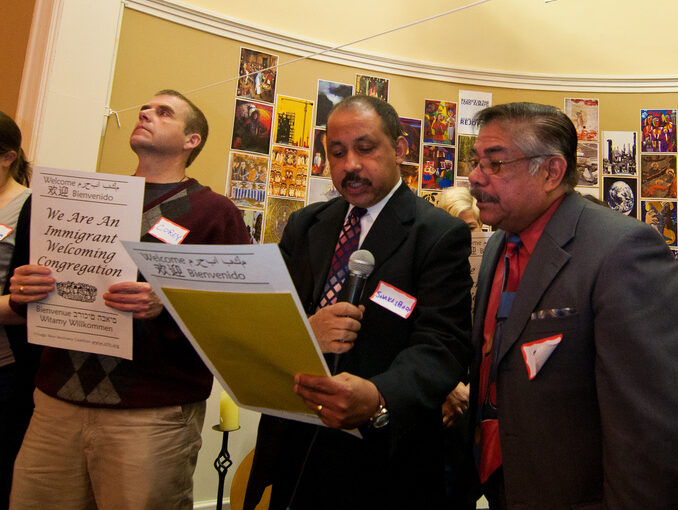
Fr. Corey (left) took part in an interfaith service in 2011 advocating for communities to welcome immigrants.
In 2010, a few years after completing studies and being ordained a priest, Fr. Corey was disturbed when an evangelical pastor in Florida made news for wanting to burn the Quran. It stirred him to explore building an interfaith organization to stand against such hate, but his cold calls and emails to synagogues and mosques did not lead to anything at the time. Then, Fr. Corey made that chance visit to the bank.
“The banker connected me to her imam from the Islamic Education Center in Glendale Heights who wanted to do what he could to get the truth about Islam out. To use Fr. Querbes’ language, that bank visit was providential,” Fr. Corey said. “It showed that when you greet someone respectfully and share knowledge of their religion, then incredible things can happen in relationship.”
Soon after, Fr. Corey’s close friend who is Jewish connected Fr. Corey with his rabbi. At the time, Fr. Corey was teaching at Saint Viator High School, so he mobilized students interested in the project. The momentum grew quickly. “Leaders from these faith communities each gathered some young people, and we discerned together. Right away, we knew that it would be the Children of Abraham Coalition (COAC),” Fr. Corey said. “We felt strongly about it being intergenerational so that adults could mentor young people and learn from their example through our action. We incorporated in our bylaws that one-third of our board must be high school or college students.”
This new group took its name from the common roots of Christianity, Islam, and Judaism in the biblical figure of Abraham, and they later welcomed the Baha’i faith community, which also identifies as an Abrahamic tradition.
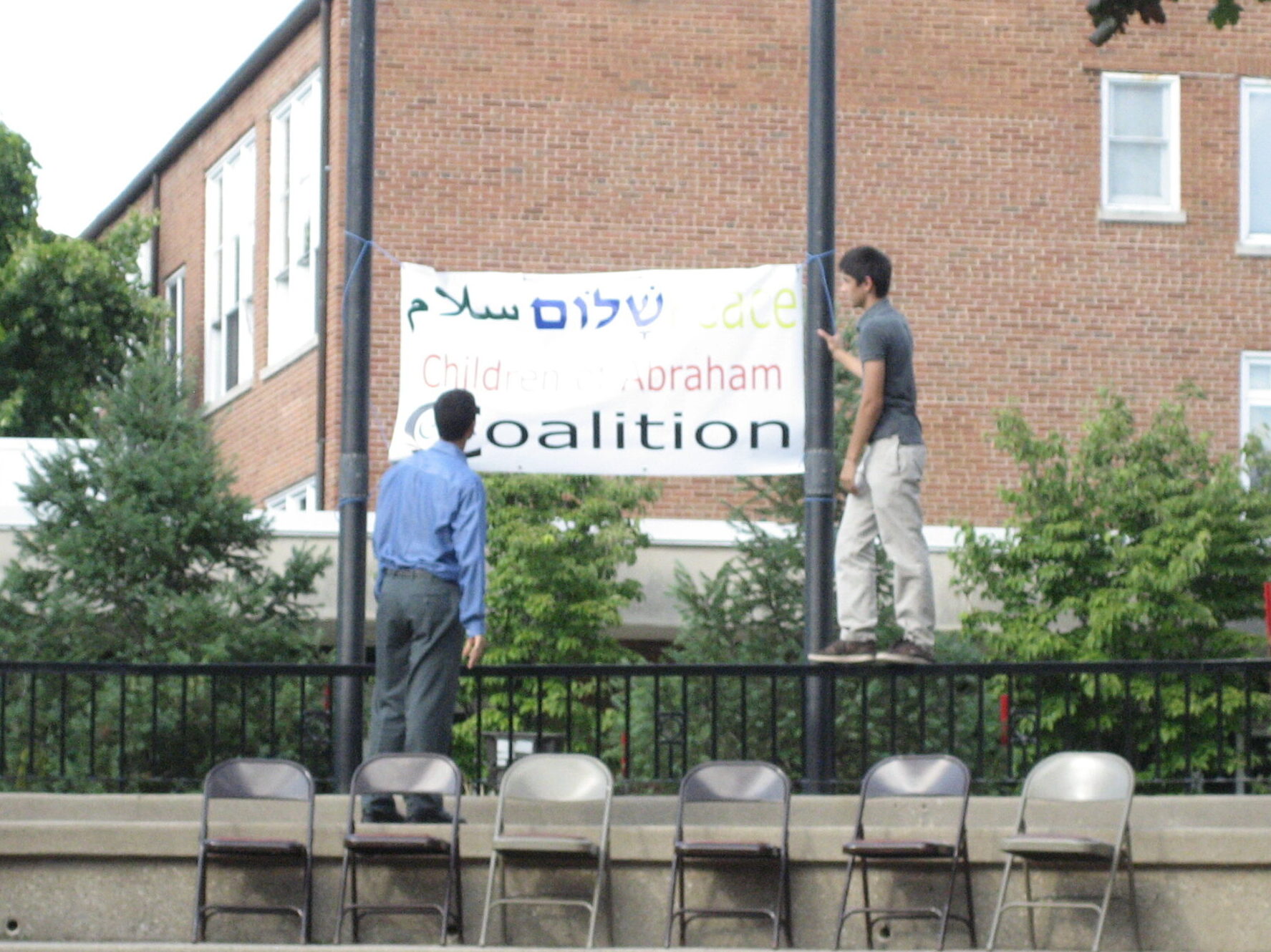
In 2011, COAC started with a prayer service commemorating the 10th anniversary of the 9/11 terror attacks, and coalition members hung the three-language peace banner that has become a staple of COAC.
New Projects for Peace
COAC started its ministry by holding a public, interfaith prayer service to commemorate the 10th anniversary of 9/11. They’ve went on to stage Potluck for Peace meals, where members of each faith tradition could gather to share culture and cuisine, eat together in mixed groups, and hear speakers from each tradition. Then, to serve young people more intentionally, COAC also started a Peace Camp for middle schoolers.
Peace Camp started in 2017 with an experimental afternoon program. Since those first participants loved it so much, it grew into a multi-day experience built on a set of visits to Christian, Jewish, Muslim, and Baha’i faith communities. During the visits, faith leaders share about their traditions, partner with young people to lead prayer experiences, and offer a welcoming environment for Q&A sessions. The relationships that all participants begin and deepen at Peace Camp facilitate a deeper sense of understanding and respect.
The Viatorian Community and other interfaith partners have helped COAC with funding, and thanks to grants, it now pays a stipend to Peace Camp’s young adult coordinators. For the next program in early 2027, Kyle Wallisch and Abbey Finn will serve in this role.
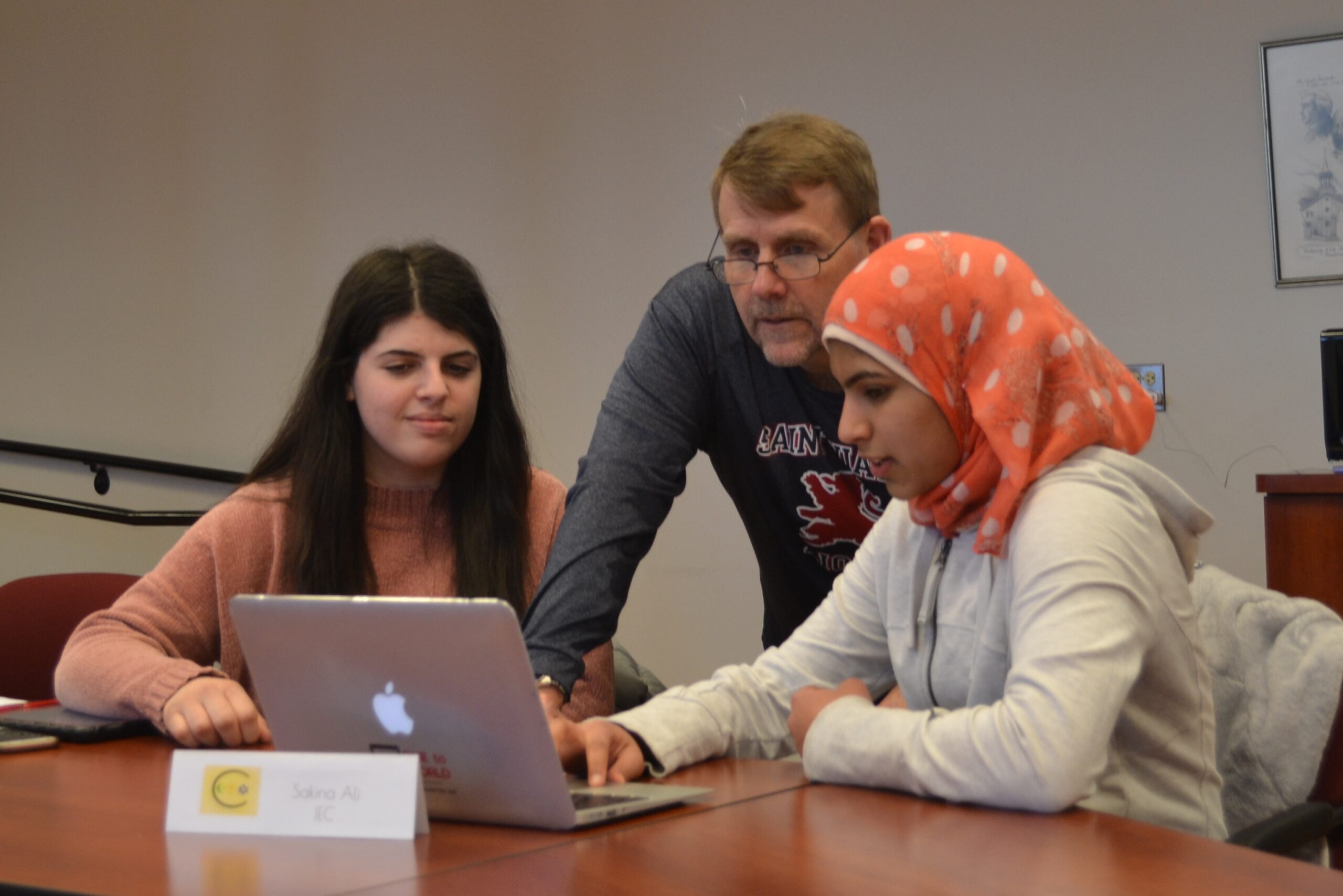
Fr. Corey (middle) helped Abbey (left) and another young leader, Sakina (right), during preparations at the Province Center for COAC Peace Camp in 2018.
Abbey is Jewish and has been involved with Peace Camp from the start in 2017, and she is now a high school teacher. “What’s unique about Fr. Corey and Peace Camp is that we spend a lot of time actively learning about each other’s faiths in person. I’ve learned about Christian traditions through visiting many churches, talking to their clergy members and faith leaders, watching different prayer services, and seeing how Mass works,” Abbey said.
Fr. Corey lives out the same hospitality to Abbey and her Jewish community that he did with his banker all those years ago. “Fr. Corey always messages me on Jewish holidays with the traditional greetings in Hebrew, showing me that he truly understands what he has learned about Judaism over the years,” Abbey added.
Kyle is Catholic, and he is a Saint Viator High School alumnus (‘22) and former Viatorian Youth Congress Young Adult Leader. He is now working as a middle school teacher. “Personally, I am kind of unusual in being naturally open-minded, but sometimes, our bubble can be quite small. When I first visited a synagogue, I had no idea what to expect. Being who I am and having a partner like Corey, I was curious and comfortable in going there, learning, and getting to know people,” Kyle said. “A big element of COAC is that we get to witness the practice of that faith in prayer or worship. Then, we get opportunities to hear directly from a rabbi and are able to ask the questions on our minds.”
The Viatorian Approach to Youth Leadership
As Abbey and Kyle take their experience with Peace Camp into leadership, the way that Fr. Corey and other Viatorians have supported them influences how they lead.
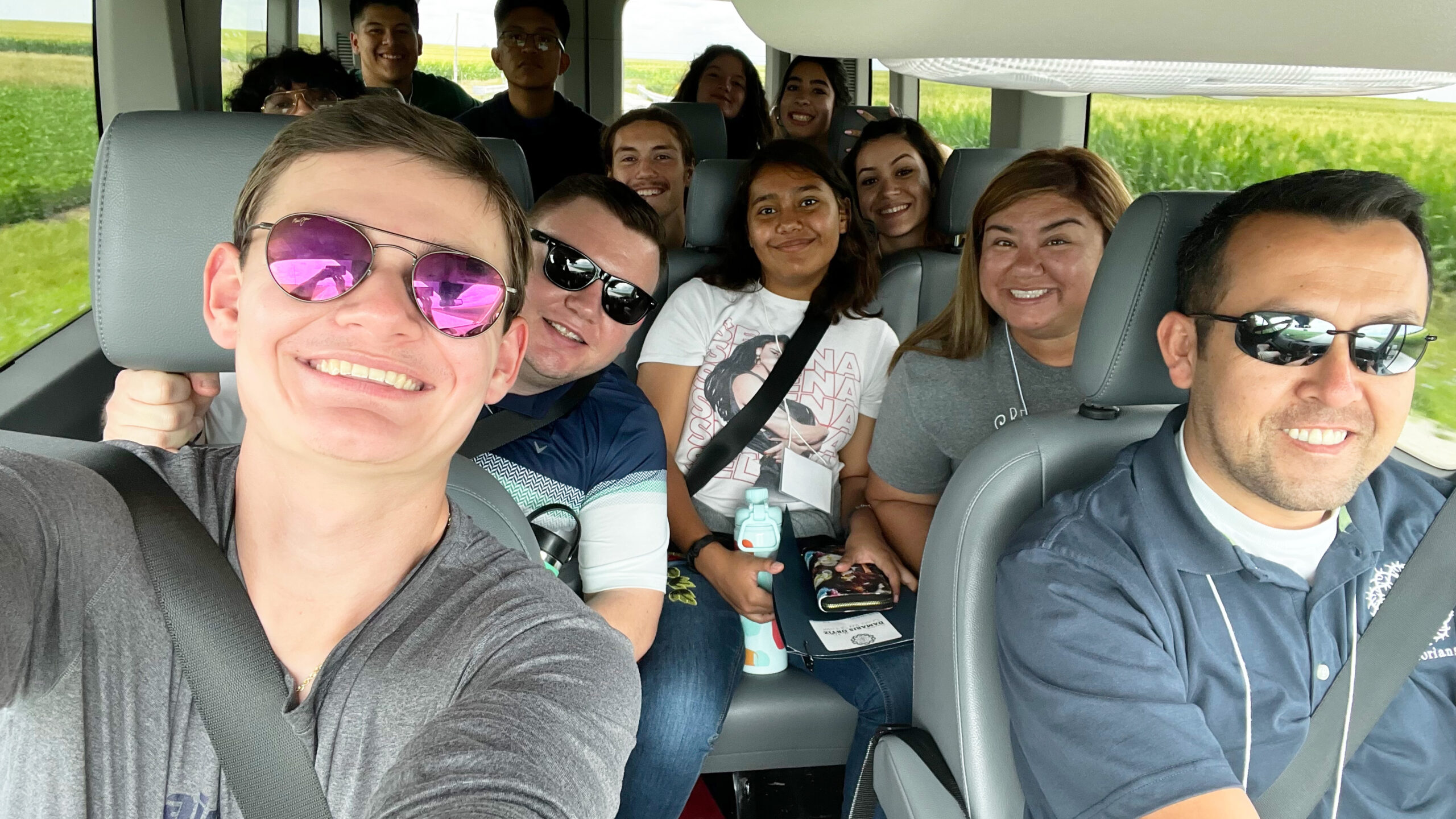
Kyle (front left) snaps a selfie from his van during VYC 2022, with Fr. Jhobany Orduz, CSV (front right), at the wheel and Associate Anthony Gugino (behind Kyle).
“As a kid, Corey would communicate invitations to me, share the things that needed to be done, and give me grace when I was learning and growing. It was definitely mentorship early on, but as I got older, it became a friendship,” Kyle said. “We’re able to get coffee, talk about life, and relate to one another comfortably. Corey is accessible to me, a consistent friend and someone who could push me to grow while supporting me in learning.”
Abbey appreciates the accompaniment approach of Fr. Corey and seeks to emulate it in her servant-leadership. “Fr. Corey approaches leadership through mentorship. Instead of leading it all himself, he gives us the tools and guidance to be leaders on our own. He is always there for us and willing to do anything to make our ideas come to life!” Abbey said. “We are now going on 10 years of Peace Camp and have reached hundreds of young campers and leaders. He always does what he can to make sure our ideas come to fruition. Plus, the Viatorian Community has always been extremely kind and welcoming – they open their spaces for us to meet, and they have given us resources to support our programming.”
It all adds up to meaningful youth leadership formation. “With Viatorians, there is just a sense of keeping it real,” Kyle said. “We address the realities of the world straight on and do not sugarcoat the problems. We name the issues of hate and misunderstanding for what they are. We want to address that now and not pass it on to future generations of young people.”
Keeping the Momentum Going
Fr. Corey had that moment in 2010 when he was not sure if this idea would go anywhere; now, he is 15 years into COAC peacebuilding and not becoming complacent. The coalition-building between multiple faith traditions and many faith communities has now also supported Viator House of Hospitality. VHH started with the vision of Br. Michael Gosch, CSV, to support young men seeking asylum, and blossomed in part with Fr. Corey helping to tap into these interfaith partnerships.
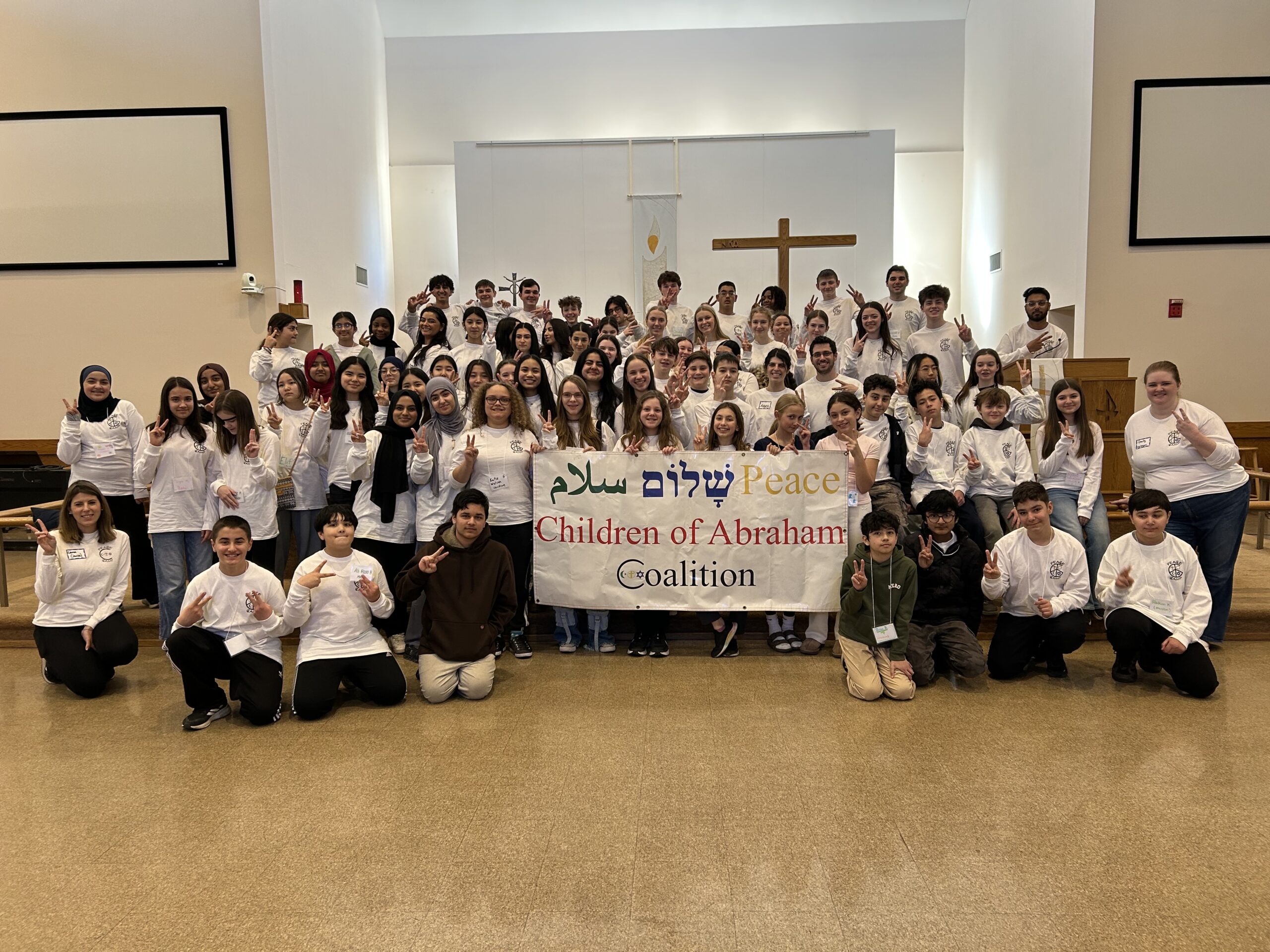
In 2026, COAC held its eighth full Peace Camp (with some limitations during the COVID era), and the group is preparing its ninth one to take place in early 2027.
Now, Fr. Corey often serves as a joyful evangelist for the courage and goodness of Viator House participants, the witness and leadership of COAC’s young leaders, and the difference that interfaith relationships make for peace in our communities. For example, in September, he was invited to be a speaker at the Journalists and Writers Foundation and United Nations roundtable discussions in New York to share about faith communities’ working together toward the common good.
Fr. Corey was awed to be speaking in between a peacebuilding legislator from the Philippines and a deputy mayor from Athens, Greece, working for environmental justice. “It was a fascinating experience – just amazing. It gave me the chance to talk about COAC a lot as well as how that laid some groundwork for us to form Viator House. I shared how we maintain this work by teaming with 26 mosques, churches, and synagogues.”
In the 19th century, the Venerable Louis Querbes founded the Viatorians with the vision of serving people who society tried to suggest were unimportant; in the wake of 9/11 in the 21st century, some tried to belittle Muslim people. “With everything I had studied and witnessed, I realized it’s up to members of a tradition to call out the hate within it. Christians needed to call out Christians who are spreading hate,” Fr. Corey said.
For 15 years and counting, these are a few of the ways Viatorians are building friendships across faith traditions and insisting that all these sisters and brothers are important.